Healthy skin continuously renews itself by shedding dead skin cells from the outermost layer of the epidermis. When this natural process slows, excess corneocytes (dead skin cells) can accumulate on the skin surface and within pores, contributing to rough texture, dullness, and congestion. Ingredients that help support orderly exfoliation are therefore common components of formulations designed for oily, blemish-prone, or combination skin.
Among botanical ingredients used for this purpose, Salix Alba (Willow) Bark Extract has gained considerable attention. Rich in naturally occurring salicin and other plant polyphenols, willow bark extract has been studied for its ability to support gentle exfoliation while also providing antioxidant and soothing properties. Rather than relying solely on aggressive exfoliation, modern formulations often use willow bark extract as part of a broader strategy to promote clearer-looking skin while maintaining skin comfort.

What Is Willow Bark Extract?
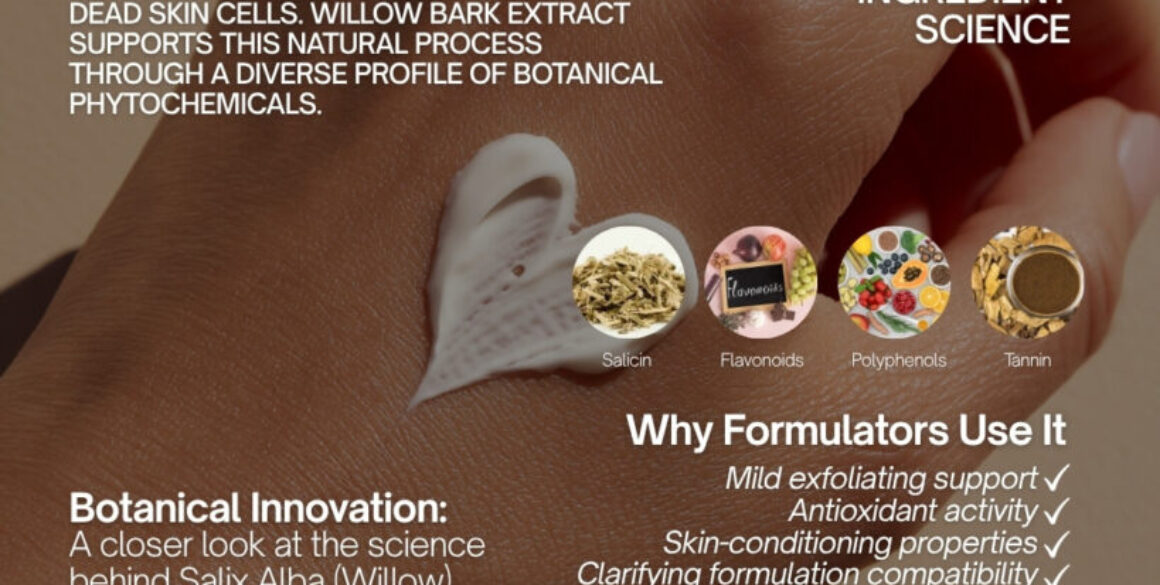
Willow bark extract is derived from the bark of various willow tree species, particularly Salix alba. For centuries, willow bark has been used in traditional herbal medicine. In cosmetic formulations, it is valued because it contains several naturally occurring phytochemicals, including:
- Salicin, a naturally occurring phenolic glycoside
- Polyphenols
- Flavonoids
- Tannins
Together, these compounds contribute antioxidant, skin-conditioning, and soothing properties that complement its exfoliating benefits.
Understanding Salicin
Salicin is often associated with salicylic acid, but the two compounds are not chemically identical.
Salicin is a naturally occurring glycoside composed of salicyl alcohol linked to glucose. When ingested, salicin can be metabolized by the human body into salicylic acid. However, this metabolic pathway does not occur in the same way when willow bark extract is applied topically to the skin.
Instead, the cosmetic benefits of willow bark extract appear to arise from the combined activity of its naturally occurring phytochemicals rather than from topical conversion into free salicylic acid. This distinction is important because willow bark extract should not be considered equivalent to salicylic acid at the same concentration.
Supporting Natural Desquamation
The outermost layer of the skin, known as the stratum corneum, consists of flattened dead cells called corneocytes. These cells are held together by specialized protein structures called corneodesmosomes, which gradually break down during the skin’s natural desquamation process.
Normal desquamation depends on carefully regulated endogenous enzymes—primarily serine proteases such as kallikreins—that degrade corneodesmosomes, allowing dead cells to shed from the skin surface.
When this process becomes impaired, corneocytes remain attached longer than they should, leading to:
- Rough skin texture
- Dull appearance
- Follicular blockage
- Increased likelihood of comedone formation
Current scientific evidence does not show that willow bark extract physically dissolves desmosomes or directly enzymatically breaks these protein structures. Instead, research suggests that formulations containing willow bark extract can help support smoother skin renewal through mild exfoliating activity while its additional phytochemicals contribute antioxidant and skin-conditioning effects.
For this reason, willow bark extract is often incorporated into formulations intended to encourage a more balanced skin renewal process without relying on high concentrations of exfoliating acids.

Follicular Congestion and Blemish-Prone Skin
One of the earliest stages of acne development is follicular hyperkeratinization, where excess keratin and dead skin cells accumulate within the hair follicle.
This accumulation can combine with sebum to create plugs that eventually develop into:
- Closed comedones (whiteheads)
- Open comedones (blackheads)
By helping maintain more regular exfoliation of surface cells, clarifying formulations containing willow bark extract may assist in reducing the buildup of excess corneocytes around follicular openings. This supports cleaner-looking pores and a smoother skin surface when used as part of a comprehensive skincare routine.
It is important to note that willow bark extract does not directly regulate sebaceous gland activity. While some studies have reported improvements in the appearance of oily skin when using willow bark-containing formulations, current evidence suggests these benefits are more likely related to improved skin surface turnover and the complementary actions of the extract’s polyphenols rather than direct suppression of sebum production.
A Botanical Alternative Within Clarifying Formulations
Synthetic salicylic acid, a beta-hydroxy acid (BHA), is well established as an effective keratolytic ingredient capable of penetrating into pores and promoting exfoliation.
Willow bark extract is sometimes described as a botanical alternative because it contains naturally occurring salicin. However, current scientific literature indicates that willow bark extract should not be considered interchangeable with salicylic acid, nor has it been conclusively demonstrated to produce identical keratolytic mechanisms.
Instead, willow bark extract offers a different profile that may appeal to formulators seeking botanical ingredients that combine:
- Mild exfoliating support
- Antioxidant protection
- Skin-conditioning benefits
- Compatibility with multi-ingredient clarifying systems
Its inclusion in well-designed formulations can therefore contribute to overall skin clarity while complementing other active ingredients.
Additional Benefits from Polyphenols and Flavonoids
Beyond salicin, willow bark extract contains numerous bioactive polyphenols that help protect the skin from oxidative stress.
Oxidative stress generated by ultraviolet radiation and environmental pollutants contributes to lipid oxidation, inflammatory signaling, and visible skin aging. Polyphenols help neutralize reactive oxygen species (ROS), supporting healthier skin function.
The extract’s naturally occurring flavonoids also contribute antioxidant activity that complements ingredients commonly used in clarifying skincare formulations.
Why Formulators Include Willow Bark Extract
Willow bark extract is rarely used as a standalone active. Instead, cosmetic chemists frequently incorporate it into formulations where multiple ingredients work together to support clearer-looking skin while maintaining skin comfort.
Its combination of mild exfoliating support and antioxidant properties makes it particularly suitable for products intended for:
- Combination skin
- Oily skin
- Congestion-prone skin
- Skin experiencing occasional blemishes
Rather than aggressively removing layers of the skin, willow bark extract contributes to a balanced skincare approach that emphasizes regular renewal and overall skin conditioning.
Catalogue Connection
Our clarifying formulations strategically incorporate Salix Alba (Willow) Bark Extract to complement ingredients chosen for blemish-prone and oily skin.
Serum Purifying
Within the Serum Purifying, willow bark extract supports skin renewal by helping maintain a smoother skin surface while contributing antioxidant benefits. Combined with other carefully selected ingredients, it forms part of a targeted approach for skin that experiences congestion and visible imperfections.
Crystal Gel Mask – Oily & Acne
The Crystal Gel Mask – Oily & Acne utilizes willow bark extract within a clarifying treatment designed to refresh oily and blemish-prone skin. Its botanical profile complements the overall formulation by supporting gentle skin renewal while helping promote a clearer, more refined complexion after regular use.
The Bottom Line
Willow bark extract remains one of the most versatile botanical ingredients used in modern skincare. Although its naturally occurring salicin is often compared with salicylic acid, current scientific evidence indicates that the extract functions through a broader combination of phytochemicals rather than acting as a direct botanical equivalent of synthetic BHAs.
Its value lies in supporting healthy skin renewal, contributing antioxidant protection, and complementing clarifying formulations designed for oily and congestion-prone skin. When incorporated into well-balanced skincare products, willow bark extract provides a botanical approach to maintaining smoother, healthier-looking skin while respecting the skin’s natural renewal processes.
References
- International Cosmetic Ingredient Dictionary and Handbook (PCPC). Salix Alba (Willow) Bark Extract.
- Draelos ZD. Cosmetic Dermatology: Products and Procedures. 3rd Edition. Wiley-Blackwell.
- Barel AO, Paye M, Maibach HI. Handbook of Cosmetic Science and Technology. 4th Edition. CRC Press.
- Elias PM. Skin barrier function. Journal of Investigative Dermatology. 2005;125(2):183–200.
- Rawlings AV, Harding CR. Moisturization and skin barrier function. Dermatologic Therapy. 2004;17(Suppl 1):43–48.
- Del Rosso JQ. The role of topical keratolytic agents in acne management. Journal of Clinical and Aesthetic Dermatology. 2013.
- Kligman AM. The pathogenesis of acne vulgaris. British Journal of Dermatology. 1974.
- Nunes AR, et al. Willow bark extract in cosmetic applications: phytochemical composition and biological activities. Cosmetics. 2021.
- European Medicines Agency (EMA). Assessment Report on Salix Species Cortex (Willow Bark). 2017.
- Mukherjee PK, et al. Phytochemical and pharmacological evaluation of willow species. Journal of Ethnopharmacology.