

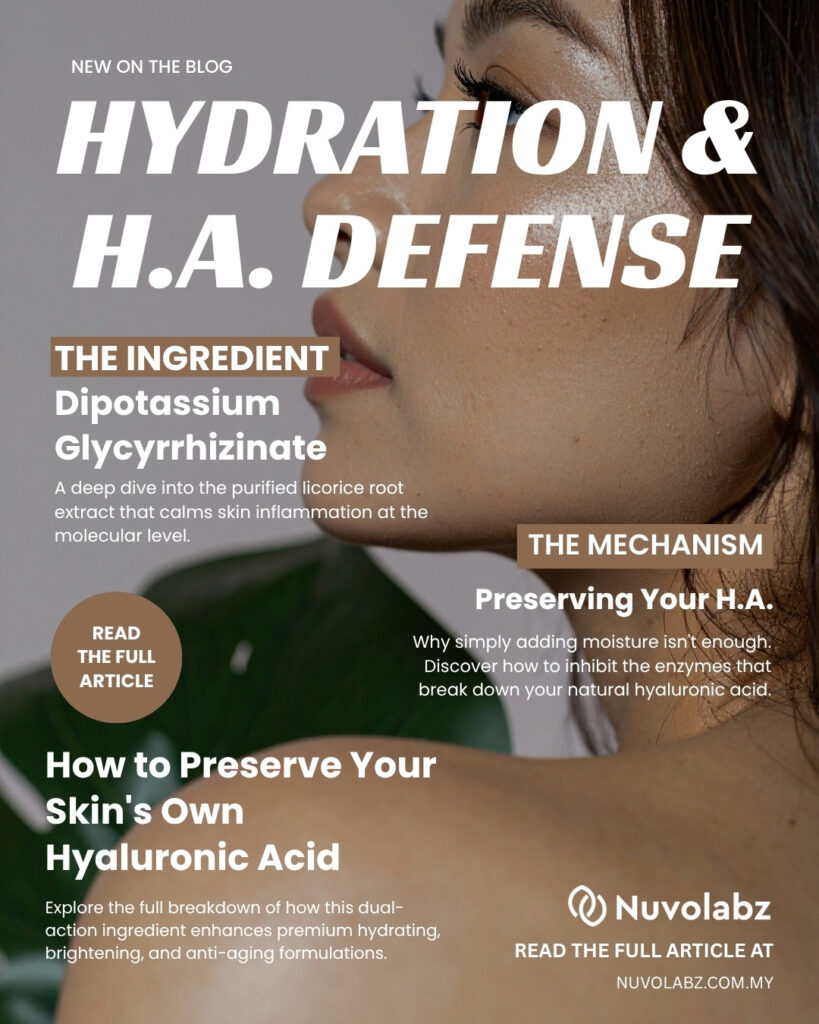
Hydration has become one of the defining goals of modern skincare, but maintaining healthy skin involves far more than simply adding moisture. The skin is constantly balancing water retention, inflammation, barrier function, and extracellular matrix remodeling. Even the skin’s own naturally produced hyaluronic acid is continuously synthesized and degraded as part of normal physiological processes.
One ingredient receiving increasing attention in advanced skincare formulations is Dipotassium Glycyrrhizinate, a highly purified water-soluble salt derived from glycyrrhizic acid, the principal bioactive compound found in licorice root (Glycyrrhiza glabra). While often recognized for its exceptional soothing properties, scientific research has shown that this multifunctional ingredient offers another important benefit: helping preserve endogenous hyaluronic acid by inhibiting the activity of the enzyme hyaluronidase.
This dual mechanism—reducing inflammation while slowing the degradation of the skin’s natural moisture reservoir—makes Dipotassium Glycyrrhizinate an important ingredient in premium hydration and skin-repair formulations.
What Is Dipotassium Glycyrrhizinate?
Dipotassium Glycyrrhizinate is the dipotassium salt of glycyrrhizic acid, extracted from licorice root. Converting glycyrrhizic acid into its dipotassium salt significantly improves its water solubility, making it highly suitable for cosmetic formulations including serums, creams, emulsions, and restorative skincare products.
Unlike many botanical extracts that contain numerous active compounds with varying concentrations, Dipotassium Glycyrrhizinate is a standardized ingredient with well-characterized biological activity. It has been widely incorporated into dermatological and cosmetic formulations because of its excellent skin compatibility, low irritation potential, and multifunctional benefits.
The First Line of Defense: Calming Inflammation at the Molecular Level
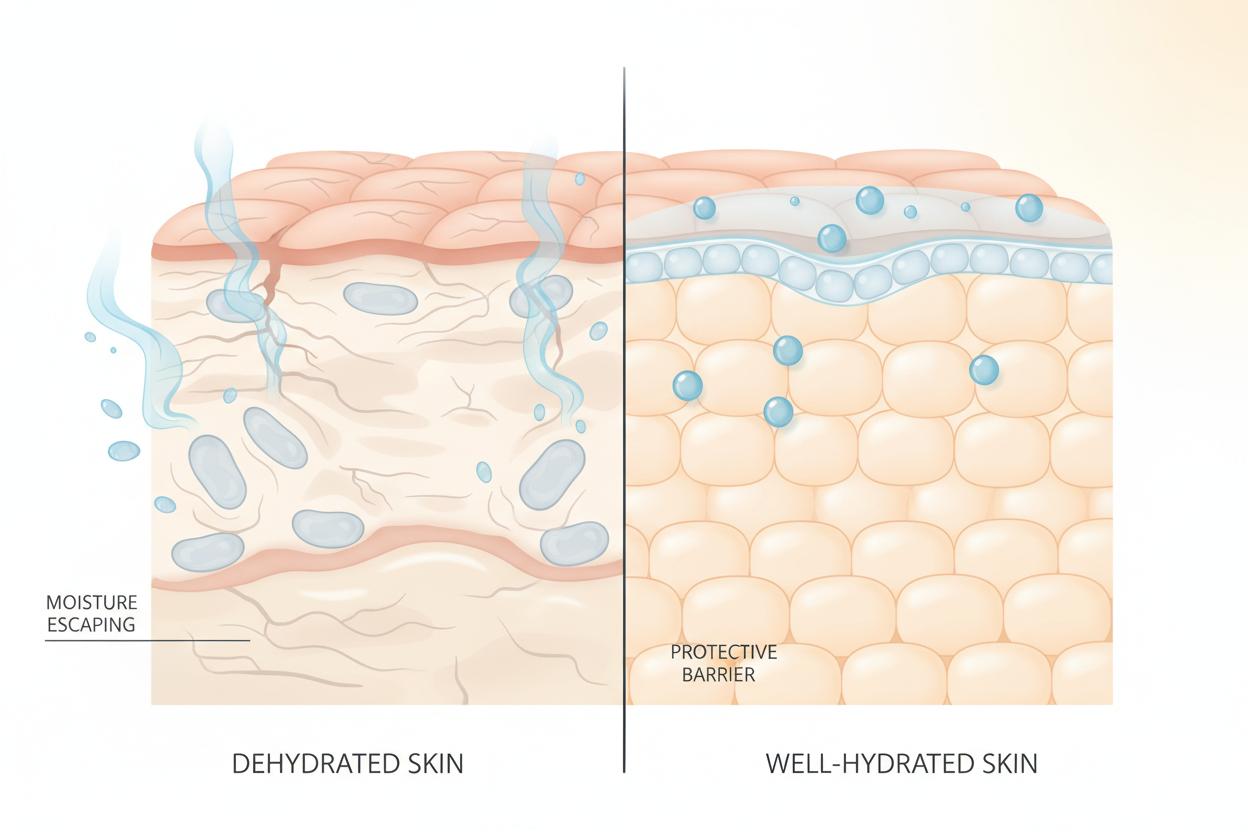
Inflammation is one of the primary contributors to impaired skin barrier function and increased transepidermal water loss (TEWL). Even low-grade or subclinical inflammation can gradually weaken the skin’s ability to retain moisture.
One of Dipotassium Glycyrrhizinate’s best-studied actions is its ability to suppress inflammatory signaling pathways.
Research suggests the ingredient can help:
- Reduce histamine-mediated skin responses
- Suppress inflammatory mediators released during irritation
- Modulate cytokine production
- Reduce redness associated with environmental stress
Histamine plays a central role in skin irritation. When mast cells release histamine in response to allergens, UV exposure, pollution, or mechanical irritation, blood vessels dilate, immune cells are recruited, and the skin often becomes red, itchy, and more permeable.
By helping regulate histamine-related inflammatory responses, Dipotassium Glycyrrhizinate contributes to a calmer skin environment, allowing the skin barrier to recover more efficiently.
For individuals with reactive, easily irritated, or compromised skin, this anti-inflammatory activity helps reduce the cascade of events that often leads to chronic dehydration.
Understanding Hyaluronidase: The Enzyme That Breaks Down Hyaluronic Acid
Most people associate hyaluronic acid with hydration because of its remarkable ability to bind water—up to approximately 1,000 times its own weight under ideal conditions.
However, the body continuously regulates hyaluronic acid through a family of naturally occurring enzymes known as hyaluronidases.
These enzymes are responsible for breaking long-chain hyaluronic acid molecules into smaller fragments as part of normal tissue remodeling.
Under healthy conditions, this turnover is essential.
Problems arise when hyaluronidase activity becomes elevated due to:
- Chronic inflammation
- Ultraviolet radiation
- Oxidative stress
- Skin injury
- Environmental pollution
- Aging
Excessive hyaluronidase activity accelerates the degradation of endogenous hyaluronic acid, reducing the skin’s ability to retain moisture and maintain structural support.
The result may include:
- Increased dehydration
- Reduced skin elasticity
- Fine line formation
- Weakened extracellular matrix
- Compromised barrier function
Hyaluronidase Inhibition: Preserving the Skin’s Natural Moisture Reservoir
One of the most interesting properties of Dipotassium Glycyrrhizinate is its reported ability to inhibit hyaluronidase activity.
Rather than supplying additional hyaluronic acid from an external source, this mechanism helps protect the hyaluronic acid already naturally present within the skin.
This distinction is important.
Many hydrating ingredients work by attracting water into the outer layers of the skin. Dipotassium Glycyrrhizinate complements this approach by helping reduce the enzymatic breakdown of endogenous hyaluronic acid, potentially allowing the skin’s own moisture-retention system to remain functional for longer.
By slowing excessive degradation, the ingredient may help:
- Support longer-lasting skin hydration
- Preserve extracellular matrix integrity
- Maintain skin suppleness
- Improve moisture retention
- Complement hyaluronic acid-based formulations
Instead of simply increasing hydration temporarily, the ingredient helps preserve one of the skin’s most important structural hydration molecules.
Supporting the Extracellular Matrix
Hyaluronic acid is a key component of the extracellular matrix (ECM), the complex network that surrounds skin cells and provides structural support.
Within the dermis, hyaluronic acid works alongside collagen, elastin, and proteoglycans to:
- Maintain tissue volume
- Support nutrient transport
- Facilitate cellular communication
- Regulate wound healing
- Preserve skin elasticity
When hyaluronic acid is degraded too rapidly, the extracellular matrix gradually loses its ability to retain water efficiently.
By helping limit excessive hyaluronidase activity while simultaneously reducing inflammatory stress, Dipotassium Glycyrrhizinate supports a healthier extracellular environment that favors barrier recovery and long-term hydration.
A Synergistic Ingredient in Advanced Hydration Formulas
Dipotassium Glycyrrhizinate is rarely used as a standalone active. Instead, it is strategically incorporated into formulations that contain other barrier-supporting and hydrating ingredients.
Its role is complementary:
- Humectants attract moisture.
- Emollients reduce water loss.
- Barrier lipids strengthen the skin surface.
- Dipotassium Glycyrrhizinate helps create a calmer environment while supporting the preservation of naturally occurring hyaluronic acid.
Because it addresses both inflammation and hyaluronic acid degradation, it enhances the performance of broader hydration systems rather than replacing them.
This makes it particularly valuable in formulations designed for sensitive, dehydrated, post-procedure, or aging skin.
Why Formulators Value Dipotassium Glycyrrhizinate
From a formulation science perspective, Dipotassium Glycyrrhizinate is prized because it offers multiple functional benefits without significantly increasing irritation risk.
Its advantages include:
- Excellent water solubility
- High compatibility with hydrating systems
- Low irritation profile
- Anti-inflammatory support
- Hyaluronidase inhibitory activity
- Barrier-supportive properties
- Suitable for sensitive skin formulations
Its versatility allows cosmetic chemists to formulate products that focus not only on immediate hydration but also on preserving the skin’s natural moisture balance over time.
Catalogue Connection: Strengthening High-Performance Skincare Systems
Because of its multifunctional properties, Dipotassium Glycyrrhizinate serves as an important supportive ingredient across several advanced skincare formulations.
Its inclusion in Serum Hydration helps complement humectants by supporting the preservation of the skin’s endogenous hyaluronic acid while helping calm irritation that may contribute to moisture loss.
Within Serum-Whitening, its soothing properties help reduce visible irritation that can accompany active brightening ingredients, improving overall skin comfort while supporting barrier integrity.
In Cream-Anti Aging, Dipotassium Glycyrrhizinate works alongside moisturizing and barrier-supportive ingredients to help maintain hydration, reduce inflammatory stress, and support the extracellular matrix, making it a valuable component of comprehensive skin-aging formulations.
Rather than acting solely as a soothing additive, it functions as a strategic buffering and preserving ingredient that helps optimize the performance of restorative skincare systems.
Conclusion
Modern skincare increasingly recognizes that maintaining hydration is not just about adding moisture—it is also about preserving the skin’s own biological systems.
Dipotassium Glycyrrhizinate exemplifies this approach through its dual mechanism of action. By helping regulate inflammatory responses, including histamine-mediated irritation, while also inhibiting excessive hyaluronidase activity, it supports the preservation of endogenous hyaluronic acid and contributes to healthier skin barrier function.
This combination of soothing and moisture-preserving properties makes Dipotassium Glycyrrhizinate a valuable ingredient in high-performance hydrating, brightening, and anti-aging formulations, particularly for skin exposed to environmental stress or prone to sensitivity.
References
- Asl, M. N., & Hosseinzadeh, H. (2008). Review of pharmacological effects of Glycyrrhiza species and its bioactive compounds. Phytotherapy Research, 22(6), 709–724. https://doi.org/10.1002/ptr.2362
- Fiore, C., Eisenhut, M., Krausse, R., et al. (2008). Antiviral effects of Glycyrrhiza species. Phytotherapy Research, 22(2), 141–148. https://doi.org/10.1002/ptr.2295
- Pulok K. Mukherjee, et al. (2011). Bioactive compounds from licorice and their applications in dermatology. Journal of Ethnopharmacology, 137(3), 1098–1110.
- Papakonstantinou, E., Roth, M., & Karakiulakis, G. (2012). Hyaluronic acid: A key molecule in skin aging. Dermato-Endocrinology, 4(3), 253–258. https://doi.org/10.4161/derm.21923
- Stern, R., & Jedrzejas, M. J. (2006). Hyaluronidases: Their genomics, structures, and mechanisms of action. Chemical Reviews, 106(3), 818–839. https://doi.org/10.1021/cr050247k
- Bissett, D. L., Chatterjee, R., & Hannon, D. P. (1987). Chronic ultraviolet radiation-induced increases in skin hyaluronidase activity and extracellular matrix remodeling. Photochemistry and Photobiology, 46(3), 367–378.
- Draelos, Z. D. (2018). Cosmetic Dermatology: Products and Procedures (3rd ed.). Wiley-Blackwell.
- Baumann, L. (2022). Cosmetic Dermatology: Principles and Practice (3rd ed.). McGraw-Hill Education.