


Ingredient science · OEM skincare development
Understanding Papaya-Derived Enzymes in Blemish Care
A closer look at papain, enzyme-based exfoliation, and the formulation decisions that matter when developing a blemish-care serum.
In cosmetic formulation, choosing an ingredient is only the beginning. Understanding how it works, how it interacts with the rest of a formula, and whether its activity can be maintained throughout shelf life are just as important. Papain, an enzyme derived from papaya, is one ingredient that has attracted interest in cosmetic exfoliation.
As a proteolytic enzyme, papain can break down certain proteins. This makes it relevant to the development of products designed to improve the appearance and texture of the skin's surface. For brands exploring blemish-care products, it offers an opportunity to consider enzyme-based exfoliation as part of a broader skincare concept. Its presence alone, however, does not guarantee a particular cosmetic outcome.

1. What Is Papain?
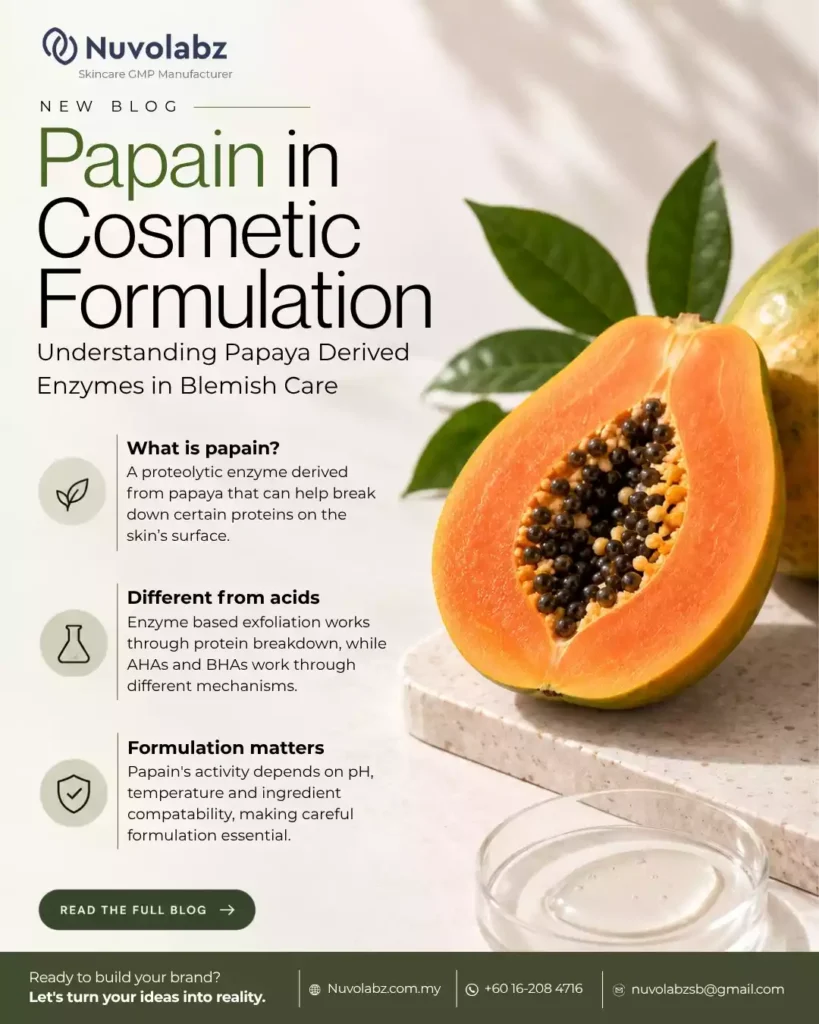
Papain is a proteolytic enzyme naturally found in papaya (Carica papaya), particularly in the latex of the fruit. It belongs to a group of enzymes known as cysteine proteases, which break down proteins by helping cleave the peptide bonds that connect amino acids.
Although papaya is widely recognised as a tropical fruit, its enzymes have applications beyond food processing. Papain has been investigated for industrial, pharmaceutical, and topical applications because of its protein-degrading activity. In cosmetics, this property makes it relevant to exfoliating formulations.
The outermost layer of the skin, known as the stratum corneum, consists of flattened, dead skin cells held together by specialised structures and proteins. Natural shedding of these cells is part of the skin's renewal process. When surface cells accumulate, skin may appear rough or uneven.
Proteolytic enzymes such as papain have been studied for their ability to break down certain proteins associated with the skin's surface, potentially helping loosen dead surface material. The extent of activity depends on factors such as enzyme concentration, formulation conditions, and the amount of active enzyme remaining when the product is used.
Formulation takeaway: The key question is not simply whether a formula contains papain, but whether the selected ingredient remains sufficiently active and suitable for its intended use.
2. How Does Enzyme-Based Exfoliation Differ from Conventional Exfoliating Acids?
Exfoliation can be approached through several mechanisms, including physical exfoliation, chemical exfoliation, and enzyme-based exfoliation. Although these approaches can serve similar cosmetic purposes, they do not work in exactly the same way.
Enzyme-based exfoliation
Papain is a protease, meaning it acts on proteins. In an appropriate formulation, its enzymatic activity may help break down proteinaceous material associated with the outermost layer of the skin. Unlike exfoliating acids, papain's primary mechanism is enzymatic protein hydrolysis rather than acid-mediated changes to the skin's surface environment.
This makes papain an interesting ingredient for brands exploring enzyme-based exfoliation concepts. However, enzyme exfoliation should not automatically be described as gentler than acid exfoliation. Tolerability depends on the specific enzyme, its concentration and activity, the formulation, frequency of use, and the individual's skin condition.
Alpha-hydroxy acids (AHAs)
Alpha-hydroxy acids, including glycolic acid and lactic acid, are widely used in cosmetic exfoliation. Their effects depend on the particular acid and formulation, including concentration, pH, and exposure conditions. AHAs can help improve the appearance of uneven skin texture and dullness by influencing processes involved in the shedding of surface skin cells.
Beta-hydroxy acids (BHAs)
Salicylic acid is a commonly used BHA in blemish-care products. It is oil-soluble and can be useful in formulations intended to address the appearance of clogged pores and blemish-prone skin. Its formulation behaviour and cosmetic role differ from those of papain, which acts through protein hydrolysis.
Understanding the differences
| Consideration | Papain | AHAs | Salicylic acid (BHA) |
|---|---|---|---|
| Ingredient type | Proteolytic enzyme | Organic acids | Beta-hydroxy acid |
| Primary mechanism | Enzymatic breakdown of proteins | Acid-mediated effects on surface-cell shedding | Keratolytic and desquamation-related effects |
| Formulation considerations | Enzyme activity, stability, pH, compatibility | Acid concentration, pH, tolerability | Solubility, concentration, pH, tolerability |
| Potential cosmetic positioning | Enzyme-based exfoliation and smoother-looking skin | Exfoliation and improved-looking skin texture | Blemish care and the appearance of clogged pores |
| Key limitation | Activity can decline during formulation or storage | Irritation can occur depending on formulation and use | Irritation or dryness can occur depending on formulation and use |
These ingredients should not be treated as interchangeable. Each has a different mechanism and requires its own formulation strategy. For OEM skincare development, the appropriate choice depends on the product concept, intended user, supporting evidence, and technical requirements of the finished formula.

3. Why Is Papain Relevant to Blemish-Care Formulation?
Blemish-care products are developed for different concerns, including the appearance of uneven skin texture, visible blemishes, and congestion-prone skin. Papain's potential role in these products relates primarily to its enzymatic exfoliation properties.
Supporting smoother-looking skin
By helping break down certain proteins associated with surface material, papain may support exfoliation when incorporated into a suitably developed formulation. Effective exfoliation can contribute to a smoother-looking skin surface. However, the cosmetic results of a papain-containing product depend on its overall formulation and cannot be inferred from the ingredient name alone.
Complementing a broader blemish-care concept
Papain can be considered as part of a formulation designed around surface renewal and skin texture. Its role should be distinguished from ingredients selected for other blemish-related functions. For example, salicylic acid is commonly used to address the appearance of clogged pores, while moisturising ingredients help support skin hydration. A well-designed blemish-care product requires a clear understanding of what each ingredient contributes to the formula.
Considering skin tolerability
Exfoliation is not beneficial simply because it removes surface material. Excessive exfoliation can contribute to irritation, discomfort, and disruption of the skin barrier. Proteolytic enzymes also require careful evaluation because their protein-degrading activity can cause irritation or allergic reactions in susceptible individuals.
Responsible product positioning: Papain should not automatically be described as treating acne, killing acne-causing bacteria, removing blackheads, or preventing future breakouts. Such claims require appropriate evidence for the finished product and may have regulatory implications depending on the market.
4. Papain Stability: An Important Consideration in Cosmetic Formulation
One of the main challenges associated with enzyme-containing cosmetics is maintaining activity throughout product development and storage. Enzymes are proteins with specific structures that allow them to perform their biological functions. Changes to these structures, or to the chemical environment surrounding them, can affect their activity.
pH compatibility
The activity and stability of papain depend on pH, temperature, the surrounding chemical environment, and the substrate being evaluated. Research on papain in topical formulations has identified pH as an important factor affecting enzyme stability. Reported optimal conditions vary with the experimental system and should not be interpreted as a universal specification for every cosmetic formula.
Many cosmetic products are formulated to be mildly acidic, while papain's activity and stability may vary across that pH range. A formulator must evaluate whether the selected papain material performs adequately at the intended finished-product pH. Simply adjusting a serum's pH to maximise enzyme activity may not be appropriate if doing so compromises other formulation requirements or skin tolerability.
Temperature during manufacturing
Manufacturing temperatures can affect enzyme activity. Although papain can retain activity under some elevated-temperature conditions, prolonged heat exposure should not be assumed harmless. Temperature and duration of exposure should be evaluated in the context of the specific ingredient material and finished formulation. Where technically appropriate, adding the enzyme during a cooler manufacturing stage may help reduce unnecessary heat exposure.
Oxidation and the chemical environment
Papain's catalytic activity depends on the condition of its active site, which includes a cysteine residue. Oxidation and interactions with other formulation components can affect this site and may reduce enzymatic activity. The formulator must consider the entire ingredient system, including other active ingredients, stabilisers, preservatives, and potential sources of incompatibility.
Moisture, packaging, and storage
A dry enzyme preparation and an enzyme incorporated into a water-based serum can behave differently during storage. Once incorporated into a formulation, the enzyme is exposed to its surrounding environment, which may influence its activity over time. Packaging and storage conditions should therefore be considered alongside the formulation itself. Light exposure, temperature fluctuations, oxygen exposure, and moisture management may all be relevant. Protective packaging may be worth evaluating, but packaging alone cannot compensate for an inherently incompatible formulation.

5. Formula Compatibility: What Should OEM Developers Evaluate?
Incorporating papain into a serum requires more than adding the raw material to an existing base. The enzyme must be evaluated within the complete formulation to determine whether the finished product meets its intended performance and safety requirements.
- Compatibility with the finished-product pH. The selected pH should support the overall formula while maintaining acceptable papain activity and product tolerability. This requires testing the actual enzyme material in the proposed formulation.
- Compatibility with other active ingredients. When papain is combined with acids, retinoids, exfoliating ingredients, or other actives, the formulator should assess combined effects on stability and skin tolerability. Combining multiple exfoliating ingredients does not automatically produce better results and may increase the likelihood of irritation.
- Preservative compatibility. Water-based serums generally require an appropriate preservation system to control microbial growth. The selected preservative system must be evaluated for microbiological effectiveness and compatibility with the enzyme. It should not be assumed that a preservative will either preserve or inactivate papain without testing.
- Processing and raw-material quality. Papain preparations can differ in enzyme activity, purity, composition, and carrier materials. OEM developers should review supplier documentation, raw-material specifications, relevant quality data, and recommended handling conditions.
- Finished-product stability. Stability assessment should consider intended packaging and storage conditions, including whether the formulation maintains acceptable physical, chemical, microbiological, and functional properties over time. Where papain activity is central to the product concept, a suitable analytical method for measuring residual enzymatic activity can provide more meaningful information than visual inspection alone.
These evaluations help determine whether papain is technically appropriate for the intended product rather than merely a promising addition to the ingredient list.
6. What Does the Research Tell Us About Papain in Cosmetics?
Scientific research supports papain's identity as a proteolytic enzyme and provides a biochemical basis for studying its use in exfoliating formulations. A 2022 review published in the Journal of Cosmetic Dermatology examined the use of proteolytic enzymes as exfoliating agents. The authors identified potential applications but also noted that relatively few clinical studies had evaluated these ingredients in people.
The review highlighted the importance of studying pH, temperature, and enzyme stabilisation, alongside the potential for irritation and allergic reactions. Research into topical papain formulations has also examined approaches to improving stability. These investigations reinforce an important point for cosmetic development: enzyme activity depends on the formulation environment and may change during storage.
Evidence that papain can break down proteins under laboratory conditions does not, by itself, establish that a particular serum will reduce acne, clear pores, fade post-blemish marks, or deliver a specific visible result. Those outcomes require evidence appropriate to the particular claim, ideally including studies of the finished product under its intended conditions of use.
7. Incorporating Papain into an OEM Blemish-Care Serum
For brands developing their own skincare lines, papain is an ingredient option worth considering when the product concept centres on enzyme-based exfoliation and the appearance of smoother skin. At Nuvolabz, papain is featured in the Blemish Care Serum, illustrating how enzyme-derived ingredients can be incorporated into OEM skincare development.
The next step is to define the product's intended role. A brand may wish to position its serum around the appearance of uneven texture, surface exfoliation, or a more refined-looking complexion. The formulation, supporting ingredients, usage instructions, and substantiation strategy should then be developed around that specific objective.
Before finalising the product, the OEM development process should address several practical questions:
- What is the intended cosmetic benefit of papain in the formula?
- Is the selected raw material suitable for the proposed product format?
- Does the enzyme retain adequate activity under the chosen formulation and storage conditions?
- Are the other ingredients compatible with the enzyme and the product's intended use?
- Has the finished product undergone appropriate stability, safety, and tolerability assessments?
- Are the proposed marketing claims supported by relevant evidence and compliant with the target market's requirements?
For brands, the value of OEM collaboration extends beyond ingredient sourcing. It also involves translating an ingredient concept into a formulation that is technically suitable, appropriately tested, and aligned with the brand's intended market positioning.
8. A More Evidence-Based Approach to Enzyme-Based Skincare
Papain illustrates how an ingredient derived from a familiar botanical source can have a specific and technically interesting role in modern cosmetic formulation. Its proteolytic activity provides a scientific rationale for investigating it in exfoliating skincare products. At the same time, its sensitivity to formulation conditions and the limited clinical evidence for some cosmetic applications highlight why careful development remains necessary.
For brands considering papain-based blemish care, the most useful questions are practical ones: What is the ingredient intended to do? Can its relevant properties be maintained in the finished formula? Is the product suitable for its intended use? And are the claims supported by evidence?
Nuvolabz's Blemish Care Serum features papain as part of its ingredient concept, offering brands a starting point for exploring enzyme-based approaches to cosmetic blemish care. Through a considered OEM development process, brands can explore how papain fits within a broader formulation strategy while keeping product claims grounded in the available evidence.
OEM skincare development
Develop a skincare concept with formulation in mind.
From ingredient selection to finished-product considerations, Nuvolabz supports brands exploring skincare product development. Start with a clear product brief and a formulation strategy built around your target market.
Explore NuvolabzReferences
- Trevisol, T. C., et al. (2022). “An overview of the use of proteolytic enzymes as exfoliating agents.” Journal of Cosmetic Dermatology. https://doi.org/10.1111/jocd.14673
- Nascimento, et al. (2024). “Enzymes for dermatological use.” Experimental Dermatology. https://doi.org/10.1111/exd.15008
- “Comparative study of the stability of free and modified papain incorporated in topical formulations.” (2011). Brazilian Journal of Pharmaceutical Sciences. Read the study
- Cosmetic Ingredient Review (CIR). “Safety Assessment of Carica papaya (Papaya)-Derived Ingredients as Used in Cosmetics.” Read the assessment
- Merck. “Papain, Cysteine Protease: Properties and Products.” Technical information on papain's biochemical properties and solution stability. Read the technical information
This article is for cosmetic formulation and educational discussion. It is not medical advice and does not establish clinical efficacy for any finished product. Product performance, safety, stability, and marketing claims should be assessed using evidence appropriate to the final formulation and target market.