

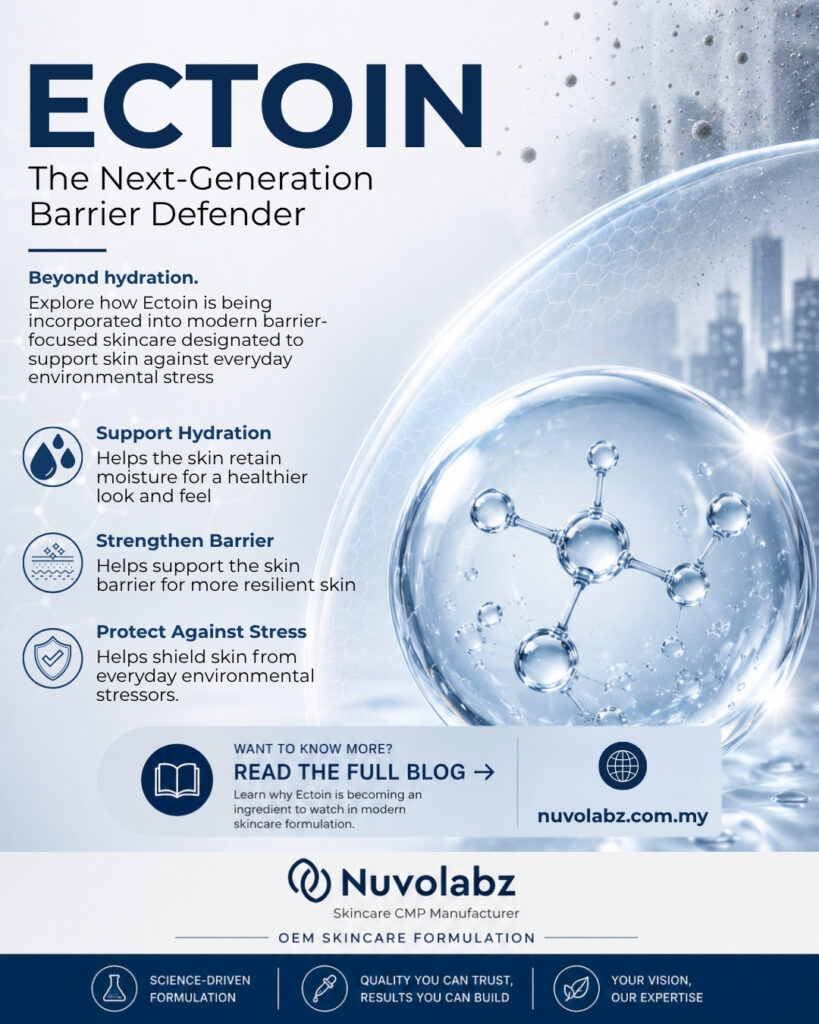
Modern skincare consumers are paying closer attention to the skin barrier, particularly as daily exposure to sun, dry air, temperature changes, cleansing and urban environments can contribute to skin dryness and discomfort.
This has created an opportunity for skincare brands to look beyond traditional moisturising ingredients and explore stress-protection ingredients that can complement a well-designed barrier-supporting formula.
One ingredient receiving growing attention is Ectoin.
Ectoin is a naturally occurring compatible solute produced by certain microorganisms that survive in demanding environments. In skincare, it is being studied for its ability to interact with water and support cellular and skin-barrier protection. Research on topical Ectoin-containing formulations has reported improvements in skin hydration and barrier-related measurements, although the exact benefits depend on the finished formulation and its intended use.
For OEM skincare developers, this makes Ectoin an interesting option for building the next generation of barrier-focused and environmental-stress skincare.
What Is Ectoin?
Ectoin is a small molecule known as a compatible solute, a substance used by certain microorganisms to help maintain cellular stability under environmental stress.
Its skincare appeal comes from its interaction with water. Scientific research suggests that Ectoin can help form a protective hydration environment around biological structures, supporting their stability under challenging conditions.
Unlike ingredients positioned primarily around exfoliation, oil control or resurfacing, Ectoin fits naturally into formulations designed around hydration, comfort and skin-barrier support.
This makes it particularly relevant for brands developing products for consumers who prefer gentle, skin-conscious routines.
How Does Ectoin Support the Skin Barrier?
The outer layer of the skin plays an important role in retaining water and helping protect the body from external environmental influences. When barrier function is compromised, skin can become more prone to dryness and sensitivity.
Research into topical Ectoin has found encouraging results in this area. An early study reported that an Ectoin-containing oil-in-water emulsion strengthened skin-barrier function based on transepidermal water loss measurements and also demonstrated protective effects against surfactant-related cellular damage.
Rather than presenting Ectoin as a guaranteed solution for every barrier concern, brands can position it as a formulation ingredient that supports hydration and barrier-focused skincare.
Ectoin and Environmental Stress
Today’s consumers encounter multiple environmental stressors throughout the day, including changes in temperature and humidity, UV exposure and airborne pollutants.
Laboratory and clinical research has investigated Ectoin in relation to different forms of environmental or physical stress. Earlier laboratory research found protective activity against UVA-induced cellular damage, while more recent research continues to explore Ectoin’s potential in cosmetic photoprotection.
However, there is an important distinction between ingredient research and finished-product claims.
An Ectoin-containing serum should not automatically be marketed as protecting skin from pollution, UV radiation or other environmental hazards unless the finished product has appropriate evidence to support that specific claim. Ectoin should also not be positioned as a substitute for sunscreen.
For brands, this creates an opportunity to communicate the ingredient more accurately:
Ectoin can be part of a skincare strategy designed to support skin hydration and resilience in the face of everyday environmental stress.
That is a more responsible approach than promising complete or “ultimate” protection.
Why Ectoin Is Relevant for Modern Barrier Skincare
Barrier care has evolved beyond simply adding an occlusive or moisturising ingredient.
Consumers increasingly look for formulas that combine several functions: maintaining hydration, supporting the skin barrier and providing a comfortable daily-use experience.
Ectoin can fit into this concept because it can be incorporated alongside other commonly used skin-conditioning and moisturising ingredients.
Depending on the product concept, an OEM formulation may combine Ectoin with ingredients such as:
- Humectants to support skin hydration
- Ceramides and skin-identical lipids for barrier-focused formulations
- Panthenol for moisturising and conditioning
- Glycerin for established humectant support
- Hyaluronic acid for hydration-focused positioning
- Soothing botanical ingredients where appropriate for the product concept
The objective is not simply to add more active ingredients. A well-designed formula should consider ingredient compatibility, concentration, texture, stability, preservation and the intended consumer experience.
From Ingredient Trend to OEM Product Concept
For skincare brands, the real opportunity with Ectoin lies in translating ingredient interest into a commercially relevant product.
A formulation featuring Ectoin could be developed into different formats depending on the target market and positioning.
Ectoin Barrier Serum
A lightweight serum can position Ectoin around daily hydration and barrier support, making it suitable for consumers who prefer layered skincare.
Ectoin Barrier Cream
A cream formulation can combine Ectoin with moisturising and emollient ingredients for a richer barrier-care concept, particularly for dry or seasonally dehydrated skin.
Ectoin Gel-Cream
For markets where consumers prefer lightweight textures, an Ectoin gel-cream can provide a more weightless sensory profile while supporting a hydration-focused positioning.
Ectoin Recovery or Comfort Formula
An OEM brand may also explore a product concept focused on skin comfort following exposure to environmental changes, cleansing or other everyday stressors.
In each case, the final claim should reflect the evidence available for the finished product rather than relying solely on the ingredient’s published research.
Why Formulation Expertise Matters
Adding Ectoin to an ingredient list is only one part of developing a successful skincare product.
The performance and positioning of the finished formula can be influenced by the entire formulation system, including:
Ingredient selection
Ectoin should be considered alongside the formula’s humectants, emollients, skin-conditioning agents and other actives.
Texture and sensory profile
The same barrier-focused concept can be developed as a watery serum, lightweight gel-cream or richer cream depending on the target audience.
Stability and compatibility
Active ingredients need to be evaluated within the complete formulation to ensure appropriate stability and product quality.
Testing and substantiation
Where a brand intends to make specific performance claims, appropriate testing should be considered for the finished product.
Regulatory compliance
In Malaysia, cosmetic claims must remain within the cosmetic scope and be supported by appropriate evidence. NPRA states that cosmetic claims should be justified by substantial evidence and/or the formulation itself, while cosmetic advertising must not be misleading or make medicinal claims.

This is especially important for claims involving words such as “protect,” “repair,” “anti-pollution” or numerical performance statements. NPRA guidance states that advertising claims must be substantiated, and quantitative performance claims require relevant evidence.
Building the Next Generation of Barrier Care
Ectoin represents an interesting direction for brands looking to develop barrier-focused skincare beyond conventional moisturisation.
Its research background in hydration, cellular protection and skin-barrier support makes it a relevant ingredient for modern formulations. At the same time, responsible product development requires brands to distinguish between what an ingredient has been studied for and what the finished cosmetic has actually demonstrated.
That distinction can become a competitive advantage.
Instead of relying on exaggerated promises, brands can build consumer trust through thoughtful formulations, credible ingredient stories and claims that are supported by appropriate testing.
For OEM skincare development, Ectoin can therefore be more than a trending ingredient. It can become part of a broader formulation strategy for products designed around hydration, barrier care and everyday environmental stress.
Developing an Ectoin Skincare Concept with Nuvolabz
For brands considering an Ectoin-based skincare product, the formulation process should begin with the desired product experience and target consumer rather than simply selecting a trending active.
At Nuvolabz, Ectoin can be explored as part of an OEM skincare concept tailored to the brand’s desired format, texture, positioning and market requirements.
From a lightweight daily serum to a richer barrier cream or modern gel-cream, the right formulation approach can help translate the Ectoin ingredient story into a practical finished product.
Looking to develop an Ectoin-based skincare product? Talk to Nuvolabz about your next OEM formulation concept.
References
- Graf, R. et al. The multifunctional role of ectoine as a natural cell protectant. Clinics in Dermatology. 2008.
- Zschocke, I. et al. Topical Ectoine Application in Children and Adults to Treat Inflammatory Diseases Associated with an Impaired Skin Barrier: A Systematic Review. 2022.
- Czech, A. et al. Ectoine-containing cream in the treatment of mild to moderate atopic dermatitis: a randomised, comparator-controlled, intra-individual double-blind, multi-center trial. 2013.
- Buenger, J. et al. Ectoin: an effective natural substance to prevent UVA-induced premature photoaging. 2004.
- NPRA Malaysia. Guidelines for Control of Cosmetic Products in Malaysia – Annex I, Part 8: Guideline for Cosmetic Claims.
- NPRA Malaysia. Guidelines for Control of Cosmetic Products in Malaysia – Annex I, Part 10: Guideline for Cosmetic Advertisement.
- NPRA Malaysia. Regulatory Requirements for Cosmetics – Cosmetic Claims and Cosmetic Advertisement.
A systematic review of topical Ectoin formulations also found evidence from several clinical studies supporting improvements in dryness and dermatitis-related outcomes, particularly with formulations containing approximately 5.5–7.0% Ectoin. However, these findings should not be interpreted as evidence that every Ectoin-containing cosmetic will deliver the same results; performance depends on concentration, formulation design, application and the specific product tested.
This distinction is important for responsible skincare marketing.