

Hair Care Formulation · Nuvolabz
Argan Oil in Hair Care: Understanding Its Role in a Well-Formulated Conditioner
Smooth, manageable hair is rarely the result of one ingredient alone. In a conditioner, the way emollients, conditioning agents and supporting ingredients work together helps shape the product’s texture, slip and overall performance.

One ingredient frequently used in hair care is argan oil, a plant-derived oil valued for its lipid composition and emollient properties. Extracted from the kernels of the argan tree (Argania spinosa), it is commonly found in conditioners, hair masks, serums and leave-in treatments.
But what does argan oil actually contribute to a hair conditioner, and how can formulators combine it with other ingredients to develop products that deliver a desirable balance of softness, slip and manageability?
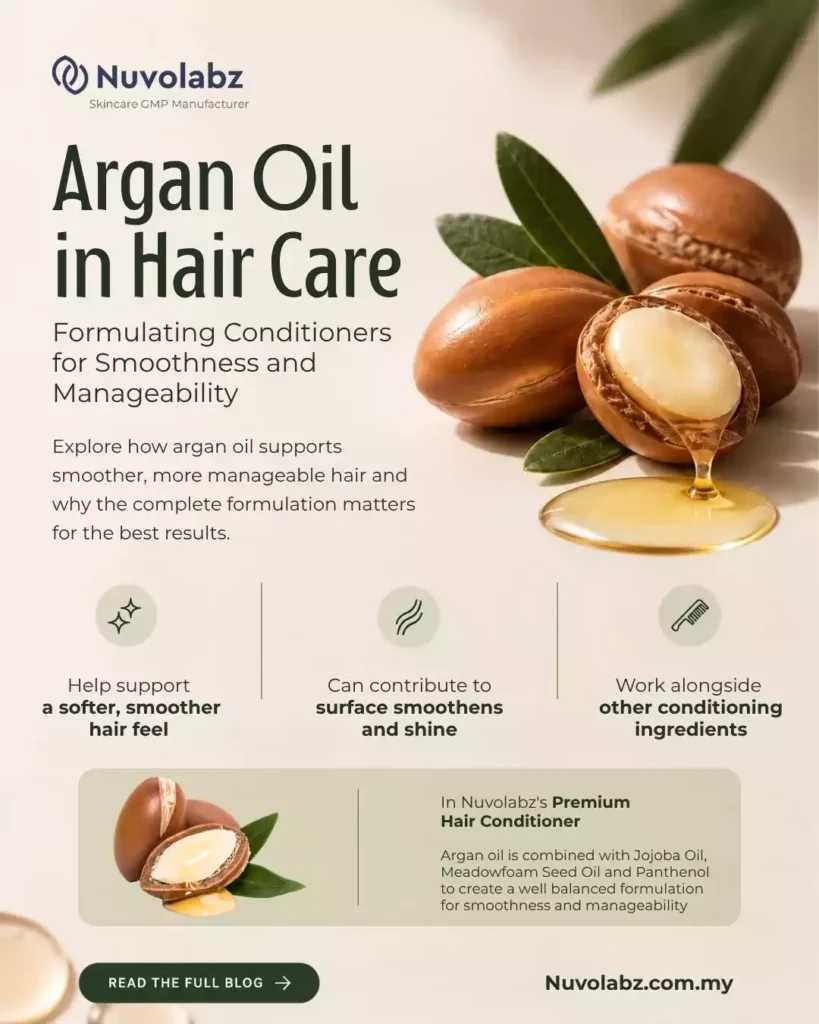
At Nuvolabz, argan oil is featured in our Premium Hair Conditioner alongside Jojoba Oil, Meadowfoam Seed Oil and Panthenol. This ingredient combination offers an opportunity to explore how complementary ingredients can contribute to a thoughtfully developed hair care formulation.
Understanding Argan Oil as a Hair-Conditioning Ingredient
Argan oil is obtained from the kernels of the argan tree, which is native to Morocco. Its composition includes fatty acids, particularly oleic acid and linoleic acid, as well as smaller quantities of other constituents, including tocopherols.
In hair care products, argan oil primarily functions as an emollient. Emollients help improve the feel of a surface by providing lubrication and reducing friction. When incorporated into an appropriately formulated conditioner, an oil such as argan oil can contribute to softness, surface smoothness and shine.
Hair fibres are made primarily of keratin and have an outer cuticle layer that influences their surface properties. Repeated washing, bleaching, colouring, heat styling and mechanical friction can contribute to changes in the cuticle and increase friction between hair fibres. Conditioning ingredients help reduce this friction, making hair easier to comb and handle. Oils may contribute by forming a lubricating layer on the hair surface.
Key takeaway: Argan oil can contribute to the conditioning properties of a hair care product, but its presence alone does not guarantee a particular level of smoothness, frizz control or manageability. Results depend on the hair, the oil, the concentration and the complete formula.
How Argan Oil Can Contribute to Smoothness and Manageability
When developing a conditioner, it is important to distinguish between the properties of an individual ingredient and the performance of the finished product. Argan oil can contribute to several desirable cosmetic characteristics.
1. Supporting a softer hair feel
Dry or damaged hair may feel rough because of changes to its surface and increased friction between fibres. As an emollient, argan oil can provide lubrication and improve the sensory feel of hair when incorporated into a suitable conditioning system. The result may be hair that feels softer and less rough after application.
The degree of softness depends on the overall formulation. The amount of oil, the conditioning system and the other emollients used can influence whether the finished product feels lightweight, rich or heavy.
2. Contributing to surface smoothness and shine
The appearance of shine is influenced by how light reflects from the hair surface. Surface irregularities can affect the way light is reflected. Oils may contribute to shine by improving surface lubrication and changing the optical characteristics of the hair’s surface.
Argan oil may therefore support a smoother-looking, glossier finish in a conditioner. However, shine is not exclusive to argan oil: silicones, film-forming ingredients and other conditioning agents can also influence the appearance of hair.
3. Helping improve hair manageability
Manageability refers to how easily hair can be detangled, combed, styled and handled. One important factor is friction between hair fibres. When friction is reduced, hair may become easier to comb, particularly when wet after shampooing.
Argan oil can contribute lubrication, but effective detangling usually relies on the broader conditioning system. Cationic conditioning agents are commonly used because they can interact with the negatively charged surface of hair fibres. Their deposition can help reduce friction and improve combing performance.
Argan Oil and Other Hair-Conditioning Ingredients
Although oils are often highlighted in product marketing, they perform different functions from many of the ingredients responsible for a conditioner’s primary detangling and conditioning effects. Understanding these differences helps formulators make more informed ingredient selections.
| Ingredient category | Primary formulation role | Potential contribution to hair feel |
|---|---|---|
| Plant oils, including argan oil | Emolliency and lubrication | Softness, surface smoothness and shine |
| Cationic conditioning agents | Hair conditioning and friction reduction | Improved detangling and combability |
| Fatty alcohols | Emolliency, thickening and emulsion structure | Creaminess, softness and a richer product feel |
| Silicones, where appropriate | Lubrication and surface film formation | Slip, shine and reduced friction |
| Humectants, including certain polyols | Moisture management within the formulation and on treated surfaces | Support for the desired conditioning feel, depending on the system |
| Panthenol | Multifunctional conditioning and humectant-related ingredient | Can contribute to softness and the sensory properties of the finished product |
These categories are not interchangeable, and individual ingredients can have more than one function. An oil may contribute lubrication without providing the same detangling performance as a suitable cationic conditioning agent. A fatty alcohol can help build the structure of a cream conditioner while contributing to its rich, smooth feel.
Effective hair conditioning is a formulation challenge involving complementary ingredients, not simply the selection of a single hero ingredient.

Beyond Argan Oil: The Role of Complementary Emollients
Combining different oils is one approach formulators can explore when developing conditioners for particular hair types and sensory preferences. However, using several oils does not automatically produce a better product. Each ingredient must be assessed in the context of the complete formula.
Nuvolabz’s Premium Hair Conditioner features three oils and Panthenol, providing an example of how different ingredient functions can be considered during product development.
Jojoba Oil: An Emollient with a Distinctive Composition
Jojoba oil is obtained from the seeds of Simmondsia chinensis. Despite its common name, it is composed predominantly of liquid wax esters rather than the triglycerides that make up most conventional plant oils. This gives jojoba oil distinctive physicochemical properties.
In hair care formulations, jojoba oil can serve as an emollient and contribute to the overall sensory profile of a conditioner. Its compatibility with other oils and conditioning ingredients, as well as the amount used, will influence the final product’s texture, spreadability and feel on the hair.
Meadowfoam Seed Oil: Another Option for Emollient Design
Meadowfoam seed oil is derived from Limnanthes alba seeds. It is known for its distinctive fatty acid profile, which includes substantial amounts of long-chain fatty acids and fatty acids containing double bonds at unusual positions. Its composition and oxidative stability characteristics make it an ingredient of interest in cosmetic formulation.
In a hair conditioner, meadowfoam seed oil can contribute to the emollient phase and influence the product’s spreading properties and sensory characteristics. Its role should be evaluated alongside the other oils to determine whether the combined oil phase delivers the desired balance of slip, softness and richness.
Panthenol: Complementing the Oil Phase
Panthenol, also known as provitamin B5, is a multifunctional cosmetic ingredient commonly used in hair care products. Unlike argan oil, jojoba oil and meadowfoam seed oil, panthenol is not a plant oil. Its formulation role is different, and it can contribute to the overall conditioning and moisture-related characteristics of a product.
Depending on the formulation, panthenol may support a softer hair feel and improve the sensory properties of the finished conditioner. Its performance depends on the concentration used, the delivery system and the other ingredients present.
Why combine these ingredients?
Argan oil, jojoba oil, meadowfoam seed oil and panthenol offer different compositional and functional characteristics. The oils contribute to the emollient phase, while panthenol provides a different type of ingredient functionality. When used together in a well-designed formula, these ingredients can be evaluated for their combined contribution to softness, lubrication, spreadability and overall conditioning performance.
The important consideration is not the number of highlighted ingredients, but whether their combined properties support the intended product experience. A successful formula should also avoid excessive greasiness, unwanted residue or a heavy finish, particularly when targeting consumers who prefer lightweight conditioners.
Formulating for Frizz: Why the Complete Conditioner Matters
Frizz is a complex cosmetic concern influenced by hair structure, environmental humidity, fibre condition, styling practices and the interaction between individual strands. When hair is damaged or its surface becomes less uniform, fibres may become more difficult to align and manage. Changes in moisture content can also influence the shape and appearance of hair, particularly in humid environments.
Conditioners can help improve the appearance and manageability of hair by reducing friction and depositing conditioning materials on the fibre surface. Emollients such as argan oil may contribute to these effects, but their performance depends on the complete formulation.
- Conditioning system selection: The type and level of conditioning agents influence detangling, combing force and the amount of material deposited on the hair. A formula for heavily processed hair may require a different balance from one intended for fine, relatively undamaged hair.
- Oil-phase composition: The choice and proportion of oils affect spreading behaviour, lubrication, texture and the potential for a heavy or greasy finish.
- Product structure and stability: Fatty alcohols, emulsifiers and other structuring ingredients help establish the texture and stability of cream conditioners. Their selection can affect how the product spreads through wet hair and how easily it rinses away.
- Hair type and intended use: Fine hair may benefit from a lighter conditioning profile, while coarse, curly or chemically treated hair may require a richer sensory experience. These are formulation considerations rather than universal rules.
- Testing under relevant conditions: A conditioner intended to improve manageability should be evaluated using appropriate methods, such as wet and dry combing tests, sensory assessments and product stability testing. Frizz-control claims should be tested under conditions relevant to the specific claim.
What Formulators Should Consider When Working with Argan Oil
Argan oil offers useful formulation possibilities, but incorporating it into a commercial hair conditioner requires more than adding it to an ingredient list.
1. Select an appropriate quality of oil
The composition and quality of argan oil can vary depending on raw material handling, extraction method and storage. Formulators should consider supplier documentation, identity, purity, relevant quality specifications and oxidation-related parameters when selecting a suitable cosmetic-grade material.
2. Establish the right concentration
A higher oil concentration does not necessarily produce better conditioning performance. Too much oil may affect spreadability, rinse-off behaviour, product stability or the feel of hair after use. Conversely, an oil level that is too low may not contribute meaningfully to the intended sensory profile. The appropriate concentration should be established through formulation trials and performance evaluation.
3. Evaluate compatibility with the full formula
Hair conditioners are often structured emulsions containing water, oils, conditioning agents, fatty alcohols and other functional ingredients. Introducing an oil changes the composition of the oil phase and may influence the finished product’s viscosity, stability and sensory characteristics. Assess the complete system rather than argan oil in isolation.
4. Assess oxidative stability
Like other plant-derived oils, argan oil can undergo oxidation under unsuitable conditions. Exposure to oxygen, heat, light and other environmental factors can influence oil quality over time. Appropriate raw material storage, packaging selection and evaluation of the finished formula can help manage these risks. Where suitable, antioxidants may also be considered as part of the formulation strategy.
5. Validate performance and product quality
Before a conditioner is introduced to the market, its performance and stability should be evaluated against the intended product specifications. Relevant assessments may include:
- Physical stability under appropriate storage conditions
- Viscosity, texture and spreadability
- Wet and dry combability
- Sensory properties, including softness, slip and residue
- Packaging compatibility
- Microbiological quality and preservation efficacy, as applicable
- Substantiation of specific product performance claims
These evaluations help establish whether the formula performs as intended and remains suitable throughout its expected shelf life.
Developing an Argan Oil Conditioner with Nuvolabz
For brands looking to develop or expand their hair care range, argan oil can be a useful starting point for exploring emollient-based conditioning concepts. However, a commercially viable conditioner requires a coordinated approach to ingredient selection, formulation design, stability, sensory evaluation and product positioning.
At Nuvolabz, our Premium Hair Conditioner features Argan Oil, Jojoba Oil, Meadowfoam Seed Oil and Panthenol. This combination provides a formulation concept centred on complementary emollients and conditioning support.
For brands exploring OEM hair care development, the formulation process can consider:
- Target hair type: Whether the product is intended for fine, dry, coarse, curly or chemically treated hair.
- Desired sensory profile: A lightweight conditioner, a richer cream, or a formula prioritising slip and detangling.
- Ingredient selection: How different oils, conditioning agents and supporting ingredients can be combined.
- Texture and application: How the conditioner spreads through wet hair and rinses away.
- Performance evaluation: How the finished product performs against its intended sensory and functional objectives.
The final ingredient combination and formulation should be selected according to the product brief, technical feasibility, safety requirements and testing results. This approach allows brands to build a hair care product around a clear consumer need while keeping ingredient claims grounded in the performance of the finished formula.
Conclusion: Argan Oil Is One Part of a Well-Designed Conditioner
Argan oil has a legitimate place in modern hair care formulation because of its emollient properties and distinctive lipid composition. In a conditioner, it can contribute to softness, lubrication, surface smoothness and shine.
Nevertheless, these benefits should not be attributed to argan oil alone. The overall performance of a conditioner depends on how its ingredients interact, the quality and concentration of the raw materials, the structure of the formulation and the results of appropriate product testing.
By combining argan oil with complementary ingredients such as jojoba oil, meadowfoam seed oil and panthenol, formulators can explore different approaches to developing conditioners that balance softness, slip and manageability. The goal is not simply to include a recognisable ingredient, but to develop a complete formula in which each component serves a purpose and the finished product delivers a consistent, well-evaluated experience.
OEM Hair Care Development
Planning Your Next Hair Care Range?
Nuvolabz can help you explore OEM hair care formulation concepts tailored to your product brief, target consumers and desired product experience.
Let’s discuss your product brief, target hair type and preferred sensory profile. Contact the Nuvolabz team to explore the next steps for your OEM hair care project.
References
- Dias, M. F. R. G. (2015). “Hair Cosmetics: An Overview.” International Journal of Trichology, 7(1), 2–15. Read article.
- Guillén, M. D., & Cabo, N. (1997). “Characterisation of edible oils and lard by Fourier transform infrared spectroscopy. Relationships between composition and frequency of concrete bands in the fingerprint region.” Journal of the American Oil Chemists' Society, 74, 1281–1286. General background on oil characterisation; not specific evidence of hair-conditioning efficacy.
- Guillaume, D., & Charrouf, Z. (2011). “Argan oil and other argan products: Use in dermocosmetology.” European Journal of Lipid Science and Technology, 113(4), 403–408. View DOI.
- Bouillon, C., & Wilkinson, J. (Eds.). (2005). The Science of Hair Care (2nd ed.). Taylor & Francis. Technical reference covering hair structure, hair damage and cosmetic conditioning principles.
- Cunningham, G. E., et al. (2025). “Exploring formulation, manufacture and characterisation techniques of lamellar gel networks in hair conditioners: A review.” Advances in Colloid and Interface Science. View PubMed record.
- Gubitosa, J., Rizzi, V., Fini, P., & Cosma, P. (2019). “Hair Care Cosmetics: From Traditional Shampoo to Solid Clay and Herbal Shampoo, A Review.” Cosmetics, 6(1), 13. View DOI.
- Fernández-Peña, L., et al. (2020). “Physicochemical Aspects of the Performance of Hair-Conditioning Formulations.” Cosmetics, 7(2), 26. View DOI.
Editorial note: These references support the discussion of argan oil composition, hair structure and general conditioner-formulation principles. They should not be interpreted as direct clinical evidence that Nuvolabz’s specific conditioner produces any particular outcome. Product-specific performance claims should be supported by appropriate testing of the finished formulation.